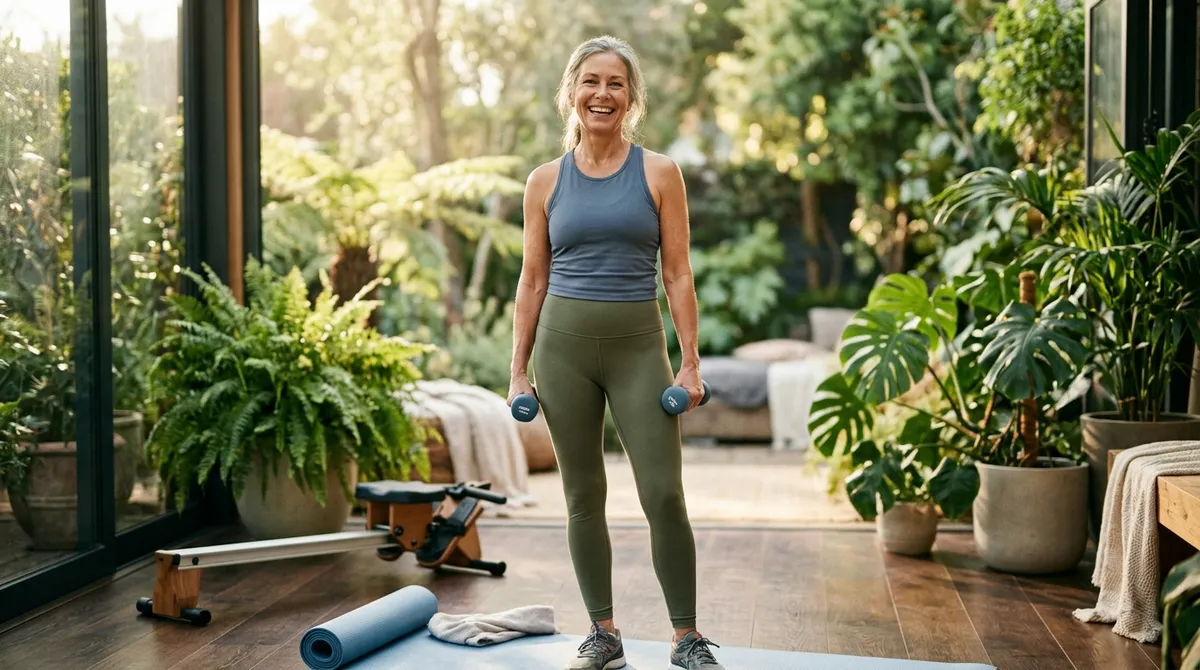
Five minutes sounds too short to matter. It isn't — especially when those five minutes are the difference between sitting in the same position for six straight hours and actually moving your body.
Pilates instructor Vanessa Michielon designed a four-move routine that hits the core, glutes, and shoulders in a single compact session. By the end of this article, you'll know exactly which moves to do, how many reps to aim for, and why this kind of "exercise snack" is worth building into your day.
What's an Exercise Snack, Exactly?
Think of it as a movement break rather than a workout. Instead of blocking an hour at the gym, you scatter short bursts of intentional movement throughout the day. The concept has picked up serious momentum as research continues to link prolonged sitting to a range of health issues, and as more people acknowledge that a packed schedule isn't going away.
The appeal is practical: no change of clothes required, no commute, no warmup that takes longer than the workout itself. Michielon's five-minute routine fits neatly into a lunch break, the gap between video calls, or the ten minutes before your day officially starts.
The 4-Move Routine
Work through these in order. Each exercise flows naturally into the next, so you're not losing time figuring out transitions.
1. Plank Knee Drives — 5 Reps Each Side
Start in a high plank with your wrists stacked under your shoulders and your body forming a straight line from head to heel. Drive one knee toward your chest in a controlled pull, then return it. That's one rep. The goal here isn't speed — it's keeping your hips level and your core switched on through every rep. Five reps per side wakes up the deep abdominals and challenges shoulder stability at the same time.
Form cue: Don't let your hips pike up when the knee comes in. The movement is in the hip flexor, not the lower back.
2. Kneeling Forearm Foldover with Leg Extension — 10 Reps Each Side
From a kneeling position, lower onto your forearms so your hips are above your knees. Extend one leg straight behind you, then fold it slowly back in. Ten reps per side. This one targets the glutes and the posterior chain while keeping the core under consistent load — because you're balancing on a narrower base, your stabilizers have to work harder than they would in a standard glute exercise.
Form cue: Keep the extended leg at hip height rather than letting it drift upward. Higher isn't better here; it just takes the glute out of the equation.
3. Kneeling Side Kick — 8 Sweeps, 10 Pulses, 8 Bicycles Each Side
This is the most complex move in the sequence, and it earns its place. Still kneeling, shift your weight onto one knee and extend the opposite leg out to the side. From there, you'll do 8 sweeps forward and back, 10 small pulses at the top of the range, and 8 bicycle circles. Then switch sides.
The sweep-pulse-bicycle combination keeps the glute under tension for an extended period without adding load — which is exactly what you want in a no-equipment routine. Your hip abductors and external rotators do most of the work, and your standing-side obliques have to fire to keep you upright.
Form cue: Sit tall through the whole sequence. The moment your torso starts leaning to compensate, you've lost the core engagement.
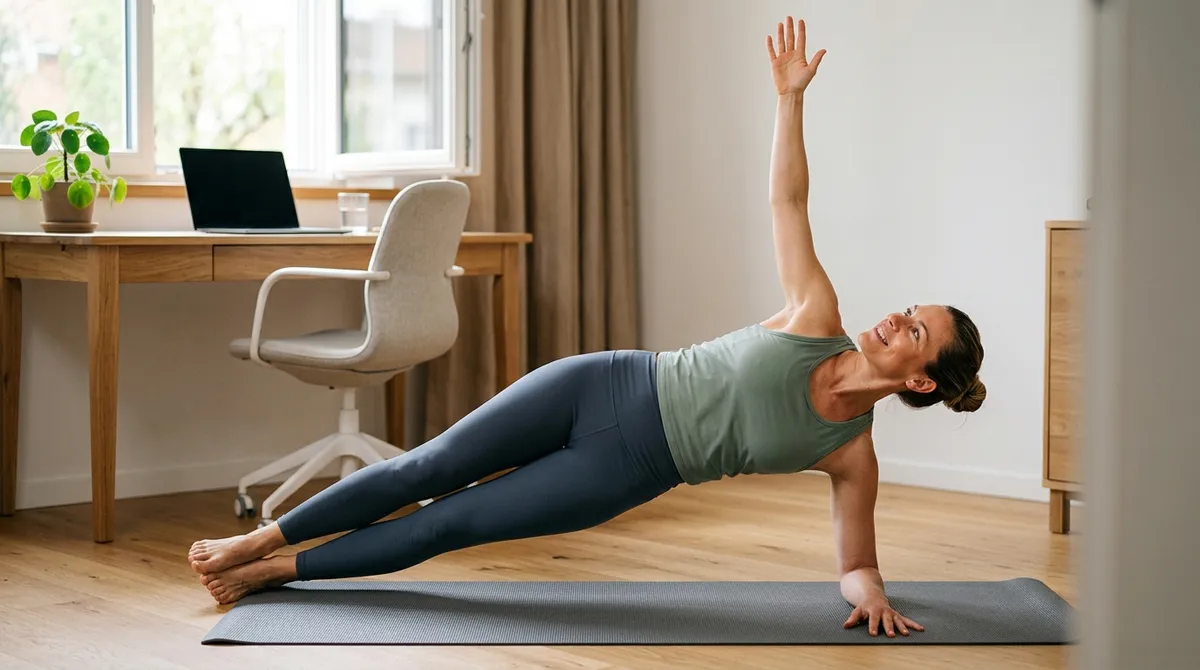
4. Side Plank with Rotation — 8 Reps + 8-Second Hold Each Side
Finish with the hardest stability challenge in the routine. Get into a side plank — either on your hand or forearm, depending on what your wrist comfort allows. From there, thread your top arm under your body in a slow rotation, then return to the start. Eight reps, then hold the side plank position for 8 seconds before switching sides.
The rotation is what makes this more than a standard side plank. It forces the obliques, deep spinal stabilizers, and shoulder girdle to work together dynamically, not just statically.
Form cue: Don't let your hips drop during the hold. If 8 seconds feels easy, you're probably compensating somewhere — check that your body is in one straight line from ankle to shoulder.
How to Fit This Into Your Day
The most useful thing about a five-minute routine is that it removes almost every excuse. Here are three realistic entry points:
- Morning: Run through it before breakfast. It's short enough that it won't feel like an obligation, but it's enough to raise your heart rate and set a movement-forward tone for the day.
- Midday: Use it as a reset after a long stretch of desk work. The side plank and plank knee drives in particular counter the forward-hunched posture that builds up over hours of typing.
- Evening: If you missed movement earlier, this is a lower-intensity way to check the box without revving yourself up so much that sleep suffers.
One round is a good starting point. If you have ten minutes, go through it twice — just add a short rest between rounds.
A Note on Consistency Over Intensity
Pilates-based movement thrives on precision and repetition, not on grinding through high-rep sets until failure. Michielon's routine is designed to be done regularly — the kind of thing you come back to because it feels good and fits your life, not the kind that wrecks you for two days.
If any of the movements feel uncomfortable at the rep counts listed, scale down and build up. The kneeling side kick sequence in particular can be shortened and still deliver results — even 5 sweeps and 5 pulses will engage the glutes if your form stays clean.
The takeaway is simple: do the routine today, and again in two days. Consistency at five minutes beats occasional perfection at an hour.